Posts Tagged ‘news’

The Visual News Loop as Emotional Abuse?

Thursday, May 6th, 2010

Is it just me? Or is anyone else disturbed about the practice of cable news shows featuring video loops of violent and disturbing footage as they describe related news reports? Yesterday CNBC was on (my husband watches the financial market openings in the morning), and they were reporting on the riots in Greece. There was a small amount of footage of rioters throwing rocks and smashing windows, and police in riot gear responding. Although there were only a few seconds of images, the disturbing footage was looped repetitively at the center of the screen, between the charts, the crawls of stock prices, and the talking heads, who were droning on about the expected impact of the Greek crisis on world markets.

I agree that the footage of rioters has news value.  Wouldn’t dream of arguing that it be kept off TV. But looping it is an “aesthetic” decision.  It’s been decided that talking heads and charts aren’t enough to maintain the coveted viewer’s attention.

Maybe they don’t care, but they should know that these disturbing visual images make it harder to focus on and absorb their verbal content.  But beyond that, viewers should know that repetitive exposure to visual images of violence and hostility causes stress.  Not only does it raise your blood pressure while watching, the effects often carry over beyond viewing, leaving you feeling unnecessarily anxious and uptight.

What can you do?

  • Consider avoiding programs that replay disturbing images gratuitously (beyond their news value)
  • Write, email, or tweet programs and let them know you don’t appreciate their practices

They’re your eyeballs … and it’s your mind, after all …

Scary News is All Around Us

Thursday, May 14th, 2009

I was recently quoted in an article that appeared in twenty newspapers in Canada, and that talked about how many frightening and sensational news stories there are on television right now. Children are highly vulnerable  to intense fear reactions as they stumble upon story after story of dread diseases (currently swine flu), images of war (from Iraq and Afghanistan), climate disasters, talk of financial collapse, and the like.  I gave my usual advice: that television news is not fit for child consumption, with its emphasis on vivid visual images of misery, hostility, and destruction.  Children need to know something (but not everything) about what’s going on in the world, but they’re much better off getting child-appropriate explanations, which more often will come from parents or other caring adults.

But let’s not forget about the impact of these swirling news stories on our own mental health. Many of the threats described in news broadcasts are so overblown that they subject us to a constant level of unhealthy stress.  We can keep up with current events and preserve our mental health better if we limit our exposure to TV news and acquaint ourselves with what’s going on by reading newspapers and checking on line — but not constantly and repeatedly all day long — at decent intervals, once or twice a day.

If you cut back on your news immersion, you’ll be amazed at how much better you feel.

Multitasking and Your Quality of Life

Saturday, January 31st, 2009

All the media at our disposal — laptops, blackberries, TVs, cellphones, ipods, old-fashioned car radios — mean we’re multitasking more and more, to the extent that “single-tasking” seems to be a rarity.  We don’t even need two gadgets to multitask anymore. We can email, IM, twitter, and surf the internet on one device, and when we watch TV news, sports, or financial shows, we watch the crawl and the changing stats while listening to the talking heads or watching an event happening.  This is “efficient” in some ways — doing more than one thing in the same time frame.  But it comes with a cost.  We definitely get less information because we can’t focus our attention on two things at once. Neuroscience has confirmed that. So what we do is get bits and pieces of the multiple things we’re trying to keep up with. We either miss a lot, or we can go back and replay what we’ve missed (not very efficient after all).  It’s true that many people feel uncomfortable with single-tasking these days: the speed of regular conversations has become too slow-moving for them. Pauses are not to be used to contemplate what has just been seen or heard or to relate it to what we already know.  Pauses are to be filled with something else!  

Switching back and forth between paying attention to two different things is difficult for our brains; we definitely lose something with each transition. When we multitask our entertainment, we also lose much of the enjoyment: Good movies are painstakingly created to give us visual images and sounds meant to be focussed on continuously; and they create a rhythm and pace designed to capture and affect our emotions. When we switch back and forth, we get less than we deserve. Maybe movie theaters will retain their allure for this reason. As I blogged a couple of days ago, football stadiums are trying to become more like living rooms, allowing people to tune into replays, ongoing stats, and other outside sources of information while in the stadium.  Apparently this is what fans want.

There are times when focusing on only one thing really enhances the experience and other times when this may not be as essential. But to get the most out of what you’re doing, it’s a good idea to be aware of which times are which.

Children’s reactions to the Wal-Mart trampling

Friday, December 5th, 2008

Today’s New York Times has an article by Judith Warner talking about how her 8-year-old daughter can’t get the news out of her head about the man who was trampled to death at Wal-Mart. Warner’s daughter’s reaction is not surprising because this is the type of news story that a child of her age is likely to take to heart: It could happen to anyone, and particularly to a child. Warner thinks her daughter’s reaction might have stemmed from her own intense reaction, which she displayed in front of her child.  This is likely because after 9/11, children were especially disturbed by seeing their parents’ intense fear and distress.

You can’t shield children from all negative news, but Warner asks: “What if your child always observes the worst?”  This mother is wise to protect her child, when she can, from the horrors her daughter doesn’t need to know about until she’s older. She’s also right to recognize that her daughter’s incessant questions mean that she is struggling to come to terms with the story and trying to get her feelings under control.

Because of my research expertise, I’ve been giving advice on helping children handle difficult news stories since the publication of my parenting book “Mommy, I’m Scared,” and you can find general recommendations on my web site, in a post I wrote about the Iraq War, but which has suggestions for dealing with all troubling news stories. In brief, when children ask about disturbing news, we should give them “the calm, unequivocal, limited truth.” They need the truth, but with a positive spin. They desperately want to know why that terrible thing cannot happen to them, and they will benefit from hearing how they can stay safe.  Warner’s instincts as a parent are right on.

All parents should take their child’s worried questions seriously and be patient in answering them — in a calm, reassuring manner. That way, their child will continue to seek them out when they are troubled, and they will benefit from one of the most important types of support a parent can give.  

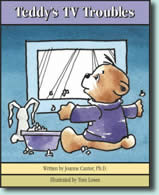
My children’s book “Teddy’s TV Troubles,” was designed to help parents and young children work through difficult issues they encounter on TV.